Wordle Solver & Helper: Find Answers Instantly
A Wordle solver helps you crack today's puzzle when you're stuck. This free Wordle solver online works as your ultimate companion for finding solutions without frustration. Our Wordle helper acts as a Wordle assistant that delivers instant results when you need them most. Think of it as a Wordle answer finder that becomes perfect comprehensive support during tough puzzles. Whether you call it a Wordle cheat or prefer "hint tool," this solver tool gives you the Wordle answer today without breaking a sweat. Finding today's Wordle answer just got easier with our cheat tool that provides the Wordle solution in seconds. This online solver stands ready as your Wordle answer finder whenever you hit a wall.
What Is a Wordle Solver and How Does It Work
A word solver takes your puzzle information and finds matching five-letter words. This puzzle solver functions as a 5-letter word finder that narrows down every possibility. Our Wordle word finder works algorithmically to become your Wordle hint generator. The Wordle solution finder relies on a sophisticated algorithm that acts as a guess optimizer.
The Wordle solver algorithm uses pattern matching to filter words in real time. Real-time filtering happens through powerful inputs you provide. This browser-based tool requires no download to start working. Information theory drives how it works, using entropy calculations to find the next best guess. The engine helpful in this process generates list solutions from thousands of candidates.
How the Algorithm Works:
- Pattern matching identifies words that fit your clues
- Entropy calculations rank words by information value
- Real-time filtering updates with each new input
- The guess optimizer suggests the most powerful inputs
- Information theory guides the next best guess selection
How to Use Our Wordle Solver
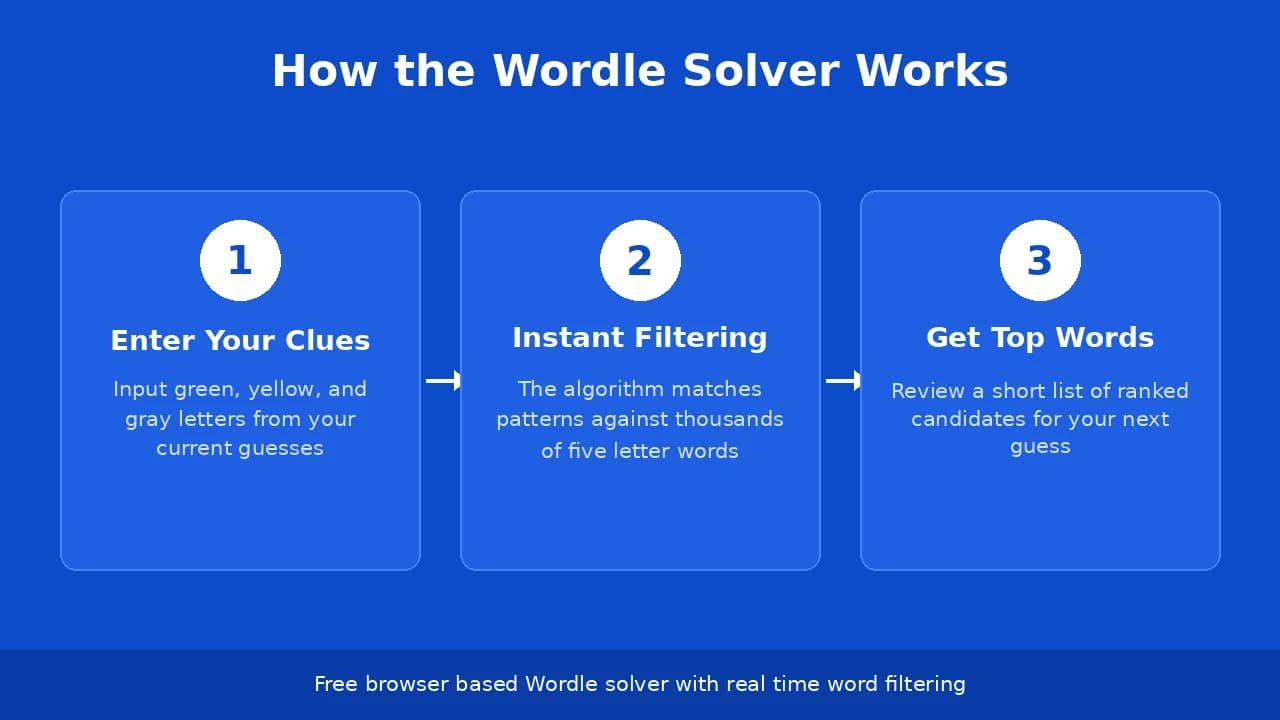
Getting started takes just seconds. Enter your information in the search bar to see instant results. The step by step process shows you exactly how to use this tool. Everything stays easy and straightforward once you begin typing.
Our simple application maintains a user friendly design. The accurate system makes filling fields complete without confusion. Each corresponding space accepts different letter types. Click the button when ready, then view your results.
Enter Your Current Progress (Green, Yellow, Gray Letters)
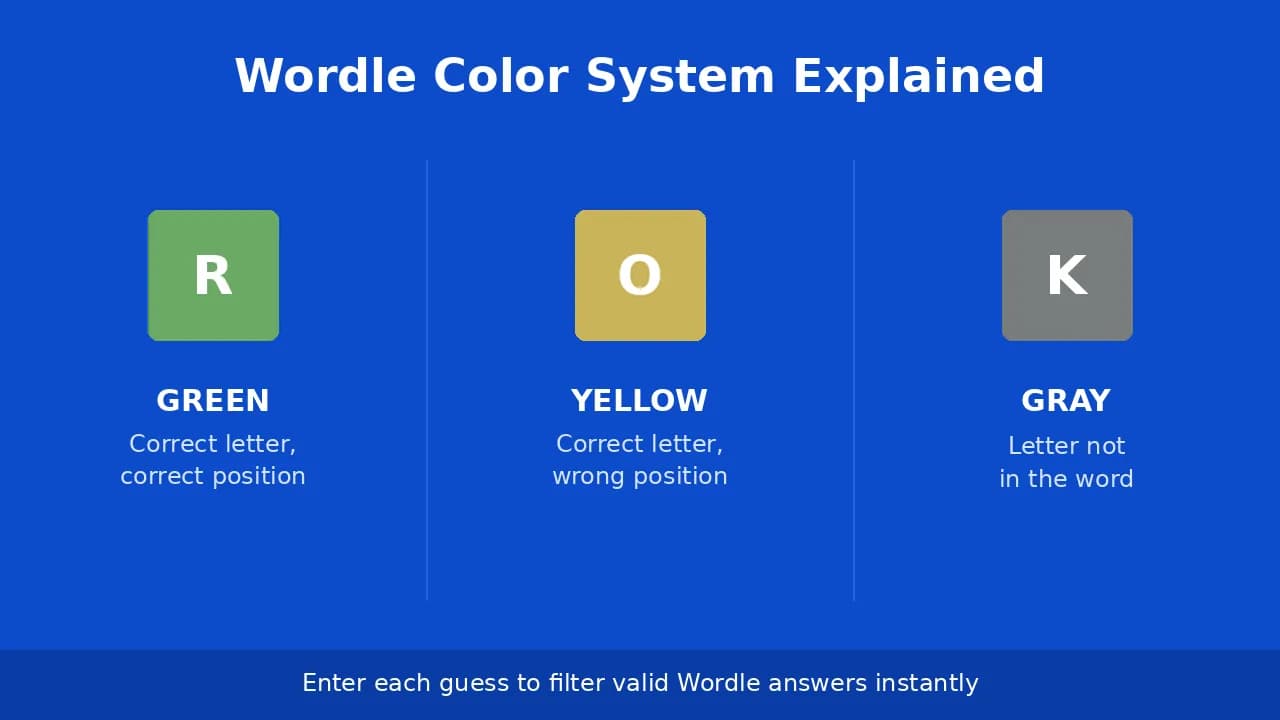
Green letters represent a correct letter in the correct position. Yellow letters mean you have the correct letter in the wrong position. Gray letters indicate a letter not in word at all.
Input your known letters in their correct spots. The green tiles show confirmed placement. Yellow tiles signal the right letter position exists elsewhere. Gray tiles mark excluded letters you've already submitted.
Letter Input Guide:
| Color | Meaning | Action |
|---|---|---|
| Green | Correct letter, correct position | Enter in exact spot |
| Yellow | Correct letter, wrong position | Mark as included elsewhere |
| Gray | Letter not in word | Mark as excluded |
Include letters that appeared in yellow. Exclude letters shown in grey tiles. Letter position matters for green blocks. Known positions lock those correct spots. Letter placement changes with each guess as tiles change color. The colour coded feedback shows which colors match your inputted data. Placed incorrectly means yellow status. The blocks cycle colour based on your match results.
Get Instant Results
Instant results appear through real-time filtering of possible words. The system generates remaining words that fit your clues. A valid words list shrinks significantly after narrowing down options.
You'll see a shortlist of candidates instead of hundreds. The tool narrows choices to a handful that match constraints. These options fit every rule you've submitted. List solutions suggest the best candidates. We prioritize words that maximize information. The system can shorten thousands down to just a few.
Results Display:
- Generate filtered word lists
- Narrowing down from full database
- Match constraints you provided
- Suggest top candidates
- Prioritize by probability
Refine Your Strategy With Each Guess
Refine your approach as you update new information. Each guess brings increasingly precise results. Your guess history builds with previous guesses you continue to add.
Make strategic and informed choice decisions with careful updating. Track your progress through the process. Repeat process steps to advance toward the answer. The targeted approach keeps you informed at every turn.
Example Walkthrough
Here's an example of a step by step demonstration. You opened the game and learned nothing from your first try. The second guess turned up some clues, but staring at the board, nothing comes to mind.
Feed the positions into our tool. You tried entering what you know. The pile of options narrows. Three letters are dead ends, eliminated completely. The system returns a short list of five words. This points you toward the answer. With just three attempts remaining, updating your third guess lets you decide confidently. The illustrated scenario shows how the tool handles a real game.
What Is Wordle
Wordle is a word game that presents one daily word puzzle. NYT Wordle, hosted by New York Times Games, offers this daily puzzle to millions. This puzzle game works as a brain teaser and vocabulary game combined. The mental exercise in this word puzzle game makes it an engaging online game. It's free to play and can be accessed once per day. The framework refreshes every 24 hours with a new challenge. This iconic game was designed to become the viral phenomenon it is today.
How to Play Wordle
Learning how to play Wordle starts with understanding the Wordle rules. You get six guesses to find the word. Six tries give you six attempts remaining on the grid. The Wordle grid displays as a gameboard with individual spaces. Each turn lets you submit one guess. The aim is simple: find the hidden word before tries run out.
Basic Gameplay:
- Begin with any 5-letter word
- Submit your guess on the board
- Check the colored feedback on each tile
- Use clues to inform your next guess
- Continue playing until you solve it or run out of attempts
- Individual letters get coded with colors after each turn
Players start the game by typing their first word. Playing means thinking strategically about each guess.
Hard Mode Rules
Hard mode adds strict rules that make the game harder. Any revealed letter must be used in your next guess. This requirement becomes forced, making certain guesses illegal. The difficulty jumps when you can't ignore confirmed clues.
Access hard mode through settings by tapping the gear icon. Select this optional level to increase complexity. The game becomes more challenging and tricky. Playing harder mode means using revealed letters effectively in every subsequent guess.
How the Color System Works
The color system provides feedback after each guess. This system uses tiles to show letter status. Colored tiles inform you about accuracy. Each colour gives a visual signal. The coded display tells you exactly what each tile means.
Green Tiles — Correct Letter, Correct Position
Green tiles confirm exact placement. A green letter means correct letter in the correct position. These correct spots are locked and confirmed. The position is right, so the letter stays highlighted. Green marks the right place. Once placed, that letter is confirmed for the final answer.
Yellow Tiles — Correct Letter, Wrong Position
Yellow signals the correct letter in the wrong position. Yellow tiles show misplaced letters. The letter exists in the word but occupies the wrong spot. It's contained somewhere else in the answer. Different placement spaces must be tested. The letter is included and present, just not in that different spot.
Gray Tiles — Letter Not in Word
Gray tiles mean the letter is not in the word at all. Grey indicates excluded and eliminated options. These letters get ruled out as absent from the answer. You can exclude any greyed letter from future guesses. They're bad picks, so keep them clear of your next attempts.
How Wordle Handles Repeated Letters
Repeated letters create tricky situations. Double letters appear in some answers. When the same letter appears twice, the game checks carefully. If the word contains exactly one instance but you guessed the same letter twice, only one tile turns yellow or green.
The system tests each position for duplicate letters. A word with double instances of a letter shows multiple colored tiles. These complex scenarios require careful attention to which positions turn what color.
Best Wordle Starting Words
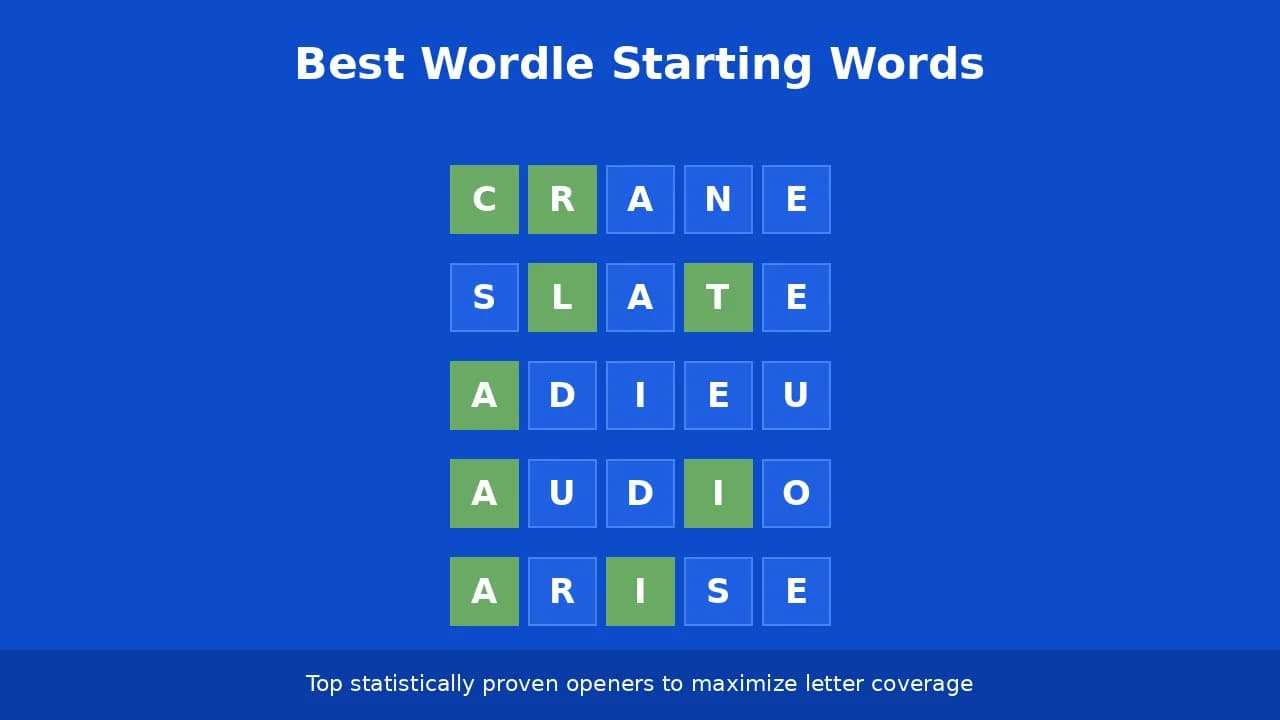
The best starting word maximizes your first guess potential. Your starting word sets the foundation. An opening word determines how quickly you solve the puzzle. The optimal first guess uses common letters. Start suggestions vary, but certain openers perform better. A top starter gives you strong starts right from the opening. Every recommended opener on this list has proven results.
Top 30 Starting Words
Here's our list of the top 30 statistically best starters:
These favorites represent popular and commonly used choices among expert players. The recommended list includes proven openers based on data analysis.
The Opening Word Problem
The opening word problem centers on choosing your first guess. Is it a matter of chance or skill? This critical decision shapes your entire game. The opening determines your path forward. Different choices create different outcomes. Starting with a disadvantage hurts your chances. Finding the right balance between vowels and consonants matters. Front loading too many vowels comes at the expense of consonant coverage. The exploratory nature presents a challenge and ongoing debate among players.
Statistically Best Starting Words
Statistically best words come from data analysis. Algorithm-driven analysis examines probability across thousands of games. The goal is to maximize coverage of common letters. High frequency letters appear in more answers. A good opener eliminates or confirms multiple letters at once.
Optimal Starting Word Criteria:
- Uses unique and distinct letters (no repeats)
- Balances vowels and consonants evenly
- Includes high frequency letters like E, A, R, O, T
- Maximizes information gained
- Optimized for efficient elimination
- Contains 3 vowels and 2 consonants ideally
The efficient approach uses these statistically optimized words.
Wordle Solving Strategy and Tips
Wordle strategy involves more than luck. Wordle tips and Wordle tricks give you an edge. Strategy guides your solving approach. These tips prove invaluable for beginners. Techniques to enhance your skills come from guidance and practice. Even seasoned players use strategic tips to navigate games with confidence. Understanding how tips for success work improves gameplay and builds mastery.
Pick a Strong Starting Word
Pick a strong starting word to make your selection critical. The first guess should maximize elimination potential. Vowel consonant balance matters in your opener. High frequency letters give broader coverage. Using unique letters avoids wasting spots on duplicates. This best practice represents a smart choice for any game.
The Two-Word Opener Technique
The two-word opener technique uses a pre selected pair of words. This paired approach covers more ground. The opener covers ten different letters total by eliminating maximum possibilities. Using this combination creates an effective strategy. Two recommended words working together represent the paired approach at its finest. The technique maximizes letter coverage while occurring across the maximum letter frequency range.
The X-Structure Theory
The X-structure theory examines letter formations and structures within words. This theory looks at pattern arrangements. Strategic formations favor certain letter placements. The framework approach uses smarter positioning. This advanced technique applies a specific methodology. The theory favors words with high-value letter structures positioned strategically.
Normal Mode Strategy — The "Elimination Word"
Normal mode offers freedom for an elimination word. This efficient way to gather information uses a filler guess. The strategic approach ignores the requirement to reuse known letters. An exploratory guess lets you test new letters. This sacrificial guess might not be the answer but reveals information. The freedom in normal mode allows this strategic approach.
Hard Mode Strategy — Surviving the Rhyme Trap
The hard mode strategy focuses on surviving the rhyme trap. A rhyme trap occurs when you discover most letters but several words fit. This dreaded scenario leaves you forced to guess among similar options. The trap snaps shut when you're locked into using revealed letters. You need escape methods and prevention tactics. One weapon against this is using a strategic filler early. The guess works by simultaneously helping you eliminate rhyming possibilities before you're stuck.
Don't Get Preoccupied With Testing Vowels
Don't get preoccupied testing every vowel. This common mistake wastes guesses. Vowels are important, but a couple well-placed ones narrows things down. Consonants contain just as much information. Wasting two full guesses on vowels throws away opportunity. Avoid being too focused on vowels. Finding the essential balance prevents throwing away valuable attempts. A balance is needed between vowel and consonant testing.
Knock Out as Many Possibilities as Possible in One Guess
Knock out the largest number of possibilities in one guess. Eliminate multiple options with each attempt. Maximize the letters you cover to reduce the greatest number of candidates. This efficiency improves your overall effectiveness. Strategic elimination proves valuable for faster solving.
Use the On-Screen Keyboard to Track Letters
The on-screen keyboard at the bottom of the game helps you track letters visually. Look at the keyboard display to see what's been eliminated or confirmed. Your eyes can intuitively scan it to spot what letters are still out there. This reference tool shows the status of every letter you've tested.
Develop Your Vocabulary to Sharpen Your Strategy
Develop your vocabulary to sharpen your strategy over time. Learn new words regularly. Increasing your knowledge helps you think of more possibilities. Memorizing common 5-letter words improves how you spell and recognize patterns. Learning new words works as both enriching entertainment and mental exercising. The benefits extend beyond the game. Dedication and practice build your word bank.
Play the Probability Game
Play the probability game by considering likelihood. Think about which letters are most likely to appear. Data reveals letter frequency patterns across English. Statistically common letters give better odds. This linguistic approach identifies smart guesses. Using mathematical thinking improves your probability of success.
Take Your Time
Take your time with each guess. There's no stopwatch or race against the clock. What matters is solving the puzzle, not speed. Stay chill and relaxing during your game. You're not in a battle against the clock. There's no rush, so think carefully. Relax and remove pressure. Enjoy the process without stress.
Letter Frequency and Wordle Statistics
Letter frequency data shows which letters appear most often. Statistics reveal patterns in Wordle answers. Data analysis of common letters separates vowels from consonants. Global benchmarks compare your performance. Analysis of these metrics provides valuable insights. These stats help you make better choices.
Letter Frequency by Position
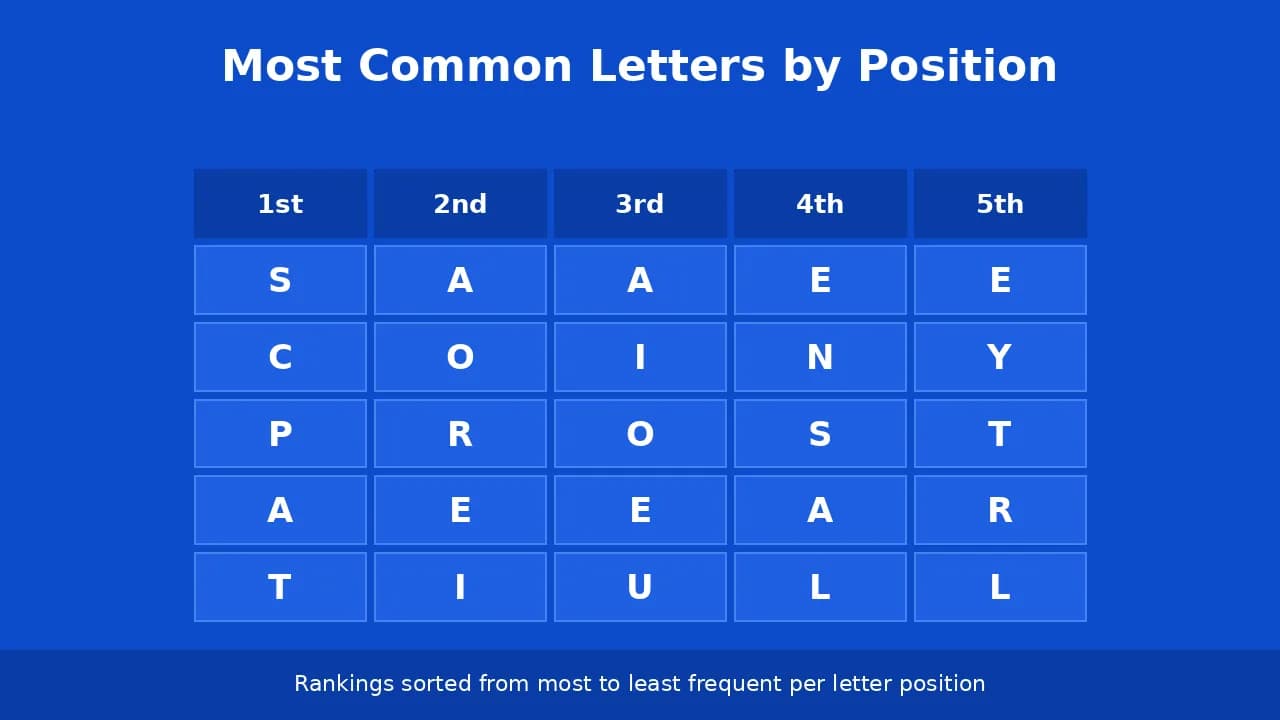
Letter frequency by position shows how placement matters. The first position favors different letters than the second position. Third, fourth, and fifth positions each have unique patterns. Positional analysis reveals that frequency differs by spot. Where letters appear varies significantly. Understanding these patterns helps target specific positions.
Letter Frequency by Position:
| Position | Most Common Letters |
|---|---|
| First | S, C, P, A, T |
| Second | A, O, R, E, I |
| Third | A, I, O, E, U |
| Fourth | E, N, S, A, L |
| Fifth | E, Y, T, R, L |
Most Common Letters
The most common letters dominate Wordle answers. The letter E is king, appearing most frequently. E leads across all positions, followed by A. R, O, and T round out the top five. These frequent letters show the highest occurrence rates. The top letters appear in more than 50% of all answers.
Least Common Letters
The least common letters rarely show up. Q, Z, X, and J are rare and infrequent. These uncommon letters seldom appear in answers. Q rarely appears outside of specific patterns. Z, X, and J sit in the bottom tier of frequency. Their low frequency makes them risky starting choices.
Global Performance Benchmarks
Global performance benchmarks compare your results to millions of players worldwide. The average player solves in 4 guesses. Here's how you stack up:
- Genius Zone: Solve in 3 or fewer regularly (top 10%)
- Solid Performance: Average 4 guesses (50% of players)
- Skilled Pack: Solve in 4-5 guesses (30% of players)
- Danger Zone: Often need 6 guesses or fail (10% of players)
Exceptional players maintain win streaks above 50 games. These statistics and benchmarks get updated monthly.
The "Weekend Effect"
The weekend effect represents an interesting pattern. Win rates drop slightly on weekends compared to weekdays. Players are less focused and more relaxed on Saturdays and Sundays. Brain power differs when you're not in work mode. These patterns and trends show performance shifts. The difficulty perception changes based on your mental state.
The Streak Breakers (Hall of Infamy)
Streak breakers are historically difficult words that ended winning streaks for thousands. These words in the hall of infamy had high failure rates. CYNIC was a disaster for many. SWILL proved brutal and cruel. NYMPH presented a triple threat with unusual letter combo. These tricky words created a vocabulary challenge. The hardest words often use uncommon letters or patterns.
The Wordle Word List
The word list contains every valid answer. The Wordle word list includes all accepted words the game uses. This list represents the complete database. The word bank draws from a specific dictionary. This lexicon contains the valid words you need to know.
What Words Does the Wordle Solver Use
What words does our tool use? It uses a curated and reviewed set matching the official game. The creator and their partner drew from multiple English dictionary sources. The Scrabble dictionary influenced some selections. Words include familiar and everyday terms. Proper nouns are excluded from the list. Most plurals don't appear as answers. The total accepted valid word count sits around 2,300 possible answers.
Popular 5-Letter Word Lists
Our 5-letter words database organizes five-letter words into popular lists. Categories include trending searches and common patterns. These lists represent compiled collections of the most searched terms.
5-Letter Words Starting With
Browse words starting with any letter. The beginning letter determines the first position. Words beginning with S are most common. Each first letter from A to Z starts different word groups. We organize by initial letter and prefixes.
5-Letter Words Ending In
Find words ending in specific letters. The last letter creates different suffixes. Words ending in E, Y, or S dominate. Final letter combinations show distinct terminations. Search by how words end and their conclusions.
5-Letter Words Containing
Search for words containing specific middle letters. If a word includes or has a letter anywhere, you can filter by it. Middle letters and contains searches help narrow options. Find words with specific letters, featuring or incorporating them anywhere in the word. You can also use our unscramble words tool or dedicated anagram solver to rearrange tricky character sets.
Wordle Uses US English, Not UK English
Wordle uses US English spelling, not UK English. Bear in mind that spelling differences matter. American spelling differs from British spelling in key ways. Words like COLOR (not COLOUR) are valid. FAVOR beats FAVOUR in this game. Language differences and lexicon differences affect valid answers. Regional variations mean UK spellings won't work.
A Quick History of Wordle
The history and story of Wordle spans just a few years. Its origins began in 2021. This timeline tracks the background and evolution. The journey from creation to phenomenon happened fast. The development chronicles an interesting path. Let's discover how it all started.
Who Created Wordle and Why
Josh Wardle created Wordle. The creator and software engineer designed it as a gift. He made it for someone he loves in his family. Wardle envisioned a simple game during quarantine. The founder loves word games and wanted to share that joy. It started as a personal project for his partner who loves word puzzles.
When Did Wordle Go Viral
Wordle went viral in late 2021. The phenomenon saw exponential growth. Popularity skyrocketed within weeks. The game took the internet by storm. Its addictive nature made it a worldwide hit. Social media sharing drove growth as players shared results. Communities grew quickly and unbelievably fast. The fan base exploded from hundreds to millions.
Why Did The New York Times Buy Wordle
The New York Times purchased Wordle in January 2022. The NYT bought the game for a seven-figure deal. This acquisition represented a major purchase. Their interest in puzzle games drove the buy. The deal gave NYT ownership and made it official. The purchase price and investment showed deep commitment to the format.
Where Can You Play Wordle
Where can you play the game? Visit the official website through New York Times Games. The website can be accessed at nytimes.com/games/wordle. This site hosts the official version. Play online from any platform. Use your desktop, smartphone, or any device. The mobile-friendly design works everywhere.
The Wordle Community
The Wordle community spans the globe. Fans and enthusiasts connect as players worldwide. Fellow puzzlers share their interactions with each other. The game encourages sharing and discussion. Its popularity created massive follower counts. Players post their results and compare scores. They discuss strategies on subreddits dedicated to the game. Hashtags on social media generate millions of uploads. The community remains fascinating as it continues to thrive.
Wordle Spin-Offs and Variants Worth Trying
Spin-offs and variants worth trying have multiplied since Wordle's success. Quordle challenges you to solve four puzzles simultaneously. Octordle increases that to eight. Dordle presents two puzzles at once. Absurdle actively works against you. Worldle tests geography knowledge. Heardle focuses on music identification. Nerdle uses mathematics instead of words. Squabble adds competitive multiplayer elements.
These similar games offer variant challenges. Alternatives inspired by the same concept provide unlimited plays. Different topics like trivia appear in these spin-offs. The variants create endless opportunities. These are neat things to explore when you finish your daily Wordle. You can also explore our Spelling Bee helper, crossword solver, Text Twist solver, Wordscapes solver, Word Cookies cheat, Wordiply solver, Words with Friends, Word Chums helper, Wordfeud helper, jumble solver, 4 Pics 1 Word solver, or generators like our anagram generator, random word generator, random letter generator, Pictionary word generator, party charades generator, and word name combiner.
Our Wordle solver gives you the support you need when puzzles get tough. Use this tool anytime you're stuck and need a fresh perspective. Whether you play daily or just discovered the game, having a reliable Wordle solver makes every puzzle more enjoyable. Come back whenever you need help cracking the code.
FAQs
Is Using a Wordle Solver Considered Cheating?
+
Using a Wordle solver depends on how you see the game. Some players use it to learn new strategies. Others grab it when stuck on a tough puzzle. The game doesn't have official rules against solvers. You're playing for yourself, not competing for prizes. If using our tool makes the game more enjoyable, that's what matters. It's your puzzle experience. Many people use it to keep their winning streak alive or just learn better word patterns.
What Makes This the Best Wordle Solver?
+
Our Wordle solver uses the exact word list from the actual game. The algorithm filters results instantly as you enter each clue. You get real words, not random guesses that won't work. The interface stays simple without confusing options. We update it whenever the official game changes. No ads interrupt your solving process. Everything happens in your browser with zero downloads needed. It just works fast and gives you actual solutions.
Does the Solver Provide Hints or Just Answers for Today's Puzzle?
+
Our solver gives you both options. Enter your current clues and you'll see every possible word that fits. The list narrows down as you add more information. You can pick any word from the results as a hint for your next guess. Or you can view the full answer if you're completely stuck. The choice stays yours. We show you all valid possibilities based on your green, yellow, and gray letters.
Does the Wordle Solver Work With the New York Times Wordle?
+
Yes, our solver works perfectly with NYT Wordle. We use the same word database that the New York Times version uses. Every update they make gets reflected here. The solver matches their exact specifications for valid answers. Whether you play on their site or app, our tool handles it. The word list and rules align completely with the official NYT version you play daily.
Does It Work for Variants Like Quordle, Dordle, or Lingle?
+
Our solver handles any game using 5-letter words. Quordle and Dordle work fine since they follow the same rules. Enter clues from each puzzle separately and get your answers. Lingle uses similar mechanics so the solver helps there too. The tool doesn't care which variant you're playing. As long as you're dealing with five letters and the standard color system, you're good to go.
Is the Wordle Solver Free to Use?
+
The Wordle solver is completely free. No subscriptions, no hidden fees, nothing. Use it once or a hundred times without paying anything. We don't ask for credit cards or personal information. No premium version exists because everything is already unlocked. Just visit, enter your clues, and get solutions. It stays free forever. That's the whole point of making this tool available to everyone.
Can I Use the Solver on Mobile Devices?
+
The solver works on any mobile device. Pull it up on your phone or tablet browser. The interface adjusts to smaller screens automatically. You can use it while playing Wordle on the same device. Just switch between apps or browser tabs. No app download is needed. Everything runs directly in your mobile browser. Touch controls work smoothly for entering your letters and viewing results.
How Often Is the Solver Updated?
+
We update the solver whenever the official Wordle changes its word list. The New York Times occasionally removes or adds words. Our database gets refreshed to match those changes immediately. The algorithm itself runs on current web standards that update automatically. You're always using the latest version when you visit. No manual updates or refreshes needed on your end.
Can I Access an Archive of Past Wordle Answers?
+
We don't host a past answers archive on this solver page. The tool focuses on helping with current puzzles you're actively playing. Past answers don't help with the solving algorithm or current gameplay. The official game doesn't reuse old answers anyway. Our purpose is solving today's puzzle or any practice round you're working on right now, not looking backward.
What's the "Cheat Word" for Wordle?
+
There's no single cheat word that cracks every Wordle puzzle. Each day brings a different answer. What people call cheat words are really just strong starting words. CRANE, SLATE, and ADIEU are popular because they test common letters efficiently. The actual answer changes daily, so no magic word exists. Our solver finds the specific answer based on your current clues, not a universal cheat code.
How Many Possible 5-Letter Words Are There in Wordle?
+
Wordle uses about 2,300 words as possible answers. The total valid guess list is much larger, around 13,000 words. Not every English 5-letter word makes the answer list. The New York Times curated which words can appear as solutions. They excluded plurals, obscure terms, and offensive words. Our solver uses both lists—the answer words and valid guesses—to give you accurate results.
How Are the Word Frequencies Determined, and Where Does the Data Come From?
+
Word frequency data comes from analyzing actual Wordle answers over time. We track which letters appear most often and in which positions. English language databases provide baseline letter frequency statistics. The New York Times doesn't publish their selection algorithm, so frequency gets calculated from observed patterns. Real game results show us what letters dominate. This data makes our solver suggest the statistically strongest options first.
Is Wordle Getting Harder?
+
Wordle difficulty feels different depending on the word. Some days are objectively trickier with uncommon letters or patterns. The New York Times doesn't intentionally increase difficulty over time. Random selection means you'll hit hard words occasionally. Repeated letters and unusual vowel patterns make certain puzzles tough. The game stays consistent in its rules. Your perception changes based on vocabulary and which words you encounter on specific days.
Is This Wordle Solver Affiliated With The New York Times?
+
This solver has no affiliation with The New York Times. We're an independent tool built to help players. The NYT doesn't endorse, sponsor, or partner with us. We simply use publicly available word lists and game rules. Our solver exists as a fan-made resource. Think of it as a helper tool created by players for players. Everything here is independent from the official game.
Why Isn't a Word I Entered Showing Up?
+
The word might not be in Wordle's accepted word list. Not every 5-letter word works as a valid guess. Check your spelling first. Make sure you entered the right letters in the correct positions. The word could be a plural or proper noun that Wordle excludes. British spellings don't work since Wordle uses American English. If the word seems valid but doesn't appear, it's probably not in the official game dictionary.