How to Use the NYT Spelling Bee Solver
This solver tool doubles as a word finder and a word game solver. Type your seven letters into the input fields, or let the shaded field show you the center letter automatically. Hit the checkmark button, and the search bar filters results instantly. You can search by letters, filter by word length, and set unique letters so no repeated letters required rule slows you down. Checkboxes let you customize the level of help, capitalize or lower case your input, and even go spoiler free. It runs as an online game with offline access for the mobile app, no downloading needed, and there's no paywall, subscription, or unlimited play mode required. This resource stays free.
Puzzle Autofill
Puzzle autofill saves time. Instead of typing every letter by hand, the tool grabs today's set and autofills the input fields for you. Every valid word combination loads automatically, so you jump straight to solving.
Choose a Date
A simple date picker lets you pick from previous puzzles, past puzzles, or the full Spelling Bee archive. Yesterday's answers and older previous answers sit right there. The tool updates daily at midnight Eastern Time, matching your local time zone automatically.
Click to Reveal Answers
Feeling stuck? One click brings up a reveal button. Reveal all shows the full list right away, or you can peek one hint at a time. This answers tool works for a quick sneak peek or a total spoiler, whichever fits your mood.
Check the Frequency Grid
The frequency grid sorts words by how often each letter shows up. Letter frequency analysis helps you spot patterns fast. Filter by word length, sort by longest words, and see exactly where most words cluster, so you can focus on the likely guesses first.
See Answer Definitions
Every answer definition comes straight from a real dictionary lookup. We pull from the English dictionary and cross-check with Merriam-Webster style dictionaries, letter by letter if needed. Click any single word for its definition and hints on how it's used.
Example Word Search
Here's how a real search plays out. A clue for a burrowing mammal points to groundhog. Folklore and a forecast both point to legend. Earth's surface leads to ground, while a religious sister gives you nun. A coast-dwelling, marine herbivore is a manatee. The top layer or covering of something is its crust. A suspended, elastic mix used in baking makes loaves and rings of bread. A casual denial of knowledge gives an unsure answer like huh. A hollow squash tied to autumn displays is a pumpkin. A persistent, chasing dog has a coarse texture and gives you hound. An approximate guess in a circular, completed cycle brings round. A gloomy expression turning to smiles points to grin. A substance used for healing or harm, depending on context, is a drug. An earthy byproduct left by beasts is dung. A wise teacher tied to devotion is a guru. A sixty-minute unit spanning daytime and nighttime is an hour. The past tense of a suspending action, held in that state, is hung. A part of speech naming an object or entity is a noun. A ladder step is a rung. Japanese noodles served in broth point to ramen. The reverse action, a reset after a mistake, is undo.
Advantages of Using a Spelling Bee Solver
Daily game solvers save real time. This solver helps you solve your favourite daily game faster, sorting through tons of combinations and millions of possibilities in seconds. It's quicker than guessing, and it helps you recognize missed answers and missed words you overlooked. As an offline word solver, it works as a spelling bee word bank, a spelling bee wordlist generator, and a spelling bee answer checker. Behind the scenes, an algorithm-based solver runs on a trie data structure and a word search algorithm, pulling from a full word database and building your own personal word list along the way.
Today's NYT Spelling Bee Answers
Spelling Bee today's answers post the moment the daily puzzle goes live, released daily at midnight EST. You'll find a complete list here every day, ready to bookmark. We also note the print version, since the puzzle runs as an alternative puzzle in the magazine alongside the popular puzzle in the digital version. Whether you check the daily puzzle release online or in print, the answer key stays current here.
Answer Definitions (Daily)
Today's word list includes definitions for every entry, so missing words and hidden words make sense once you fill them in. This covers bonus words, obscure words, and common words alike. You'll see root words broken down with their suffixes and prefixes, plus compound words, plural words, and plurals. Word frequency notes help too, along with proper nouns, abbreviations, and hyphenated words when an obscure term shows up.
Today's Pangram
Every puzzle hides at least one pangram, and today's pangram finder points straight to it. An elusive pangram uses every letter in the set at least once. Some days bring a tough pangram, and we flag every one of today's pangrams so you never miss it.
What Is the NYT Spelling Bee Game?
NYT Games publishes the Spelling Bee as part of its New York Times games lineup, inside the NYT Games app. A puzzle creator and puzzle editor curate each set by hand. It launched as a modern twist on a classic spelling challenge, and it quickly became a fan favorite thanks to its simple format. As one of the word puzzle games under the NYT umbrella, it's popular, addictive, and edited daily by a journalist-led team. Editors make every editorial decision, drawing on years of schooling in language, to keep each game fair and fresh.
History of the Spelling Bee Game
Sam Ezersky built the modern digital version of Spelling Bee for the New York Times. The name borrows from real spelling competitions, where pronunciation and spelling skill matter as much as memory. A pronunciation competition or spelling competition often runs as a national contest, sometimes with a cash prize, growing out of local contests across many states. Each winner earns real recognition, often through sponsorship, held annually with new competitors testing their knowledge of spelling. Since revealing spelling in a word-grid format, this modern version of the game has only grown in popularity.
Where to Play
You can play through the NYT Games app on your phone, or online through a browser. It works offline once loaded, though most players prefer the app for daily syncing. NYT subscribers can also find a mini crossword nearby, tucked into the upper right menu, right next to Spelling Bee.
How to Play the NYT Spelling Bee
This puzzle-based game runs on a simple arrangement of letters. The gameplay mechanics and puzzle mechanics stay consistent every day, built around clear rules. Every game criteria and format stays the same, so once you learn it, you're set for good.
Rules and Format
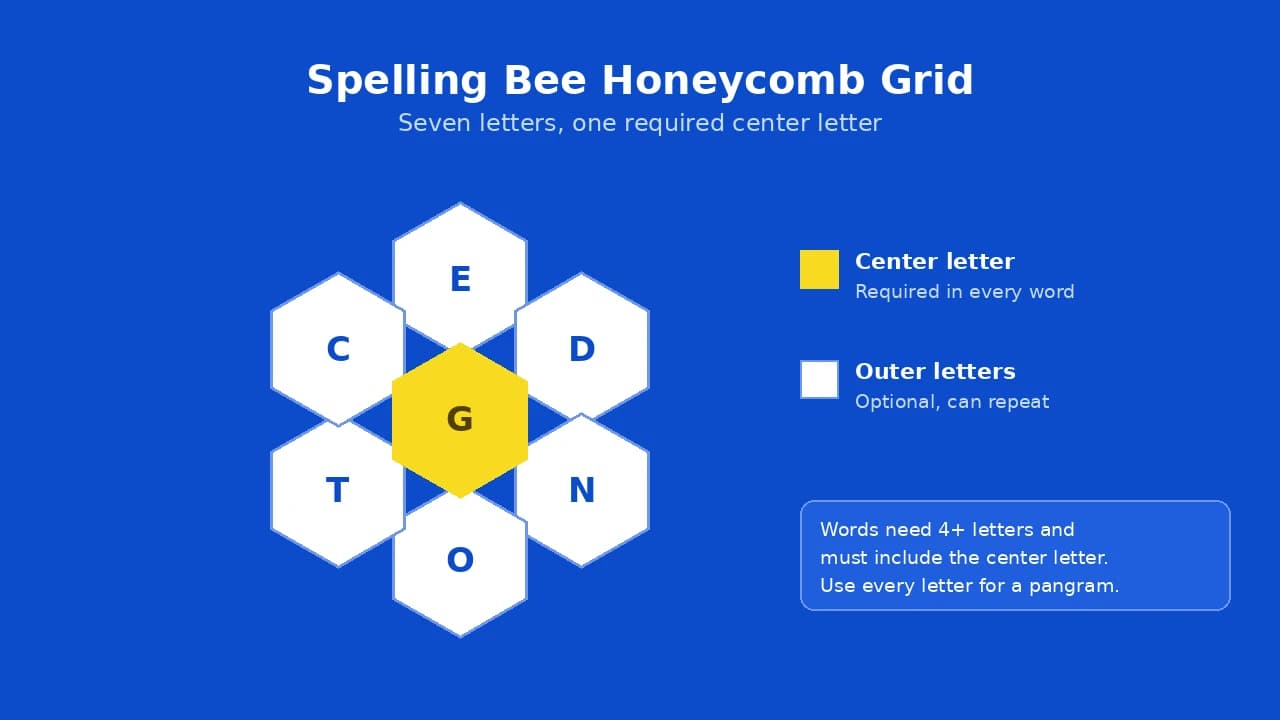
The board uses a hexagon grid, often called a hexagonal grid, shaped like a honeycomb. Picture a beehive built from small honeycombs, each one a hive of letters. You get seven letters total, all seven unique letters, arranged around one center. Words need a four-letter minimum, so any entry under those minimum letters and characters long doesn't count. One letter sits in the required letter spot, called the center, while the rest are optional letters. That central letter, always highlighted in yellow, sits in a yellow tile or yellow hexagon against the yellow background, and a small star marks pangrams once you find them.
How Letters Are Chosen
Editors pick each day's letter sets by hand. They test letter combinations and letter permutations, along with specific letter pairs, before a puzzle goes live. This curated process helps balance difficulty for beginners and experts alike. There's no maximum on how many words a set can hold. If a set feels off, a shuffle button lets you try reordering the outer letters, since it's just your turn and repeat letters stay visible the whole time.
What Counts as a Valid Word
Only valid words from the accepted word list count, and word validation happens instantly. Every word submission, or word list submission, gets checked before it's rejected or accepted. Offensive words and inappropriate words never count, and neither do acronyms. Verb forms are fine, but a word needs to be four letters long, since four letter words mark the maximum and minimum length by letter requirement and letter usage. We check every valid word against a real dictionary, similar to Scrabble and the Scrabble dictionary used in Words With Friends. Think of it as a built-in anagram solver and word unscrambler, unscrambling entries the moment you submit them, backed by a full English word finder.
Scoring System
Here's how the scoring system breaks down:
| Word Length | Points Awarded |
|---|---|
| 4 letters | One point |
| 5+ letters | One point per letter |
| Pangram | Word length points plus 7 bonus points |
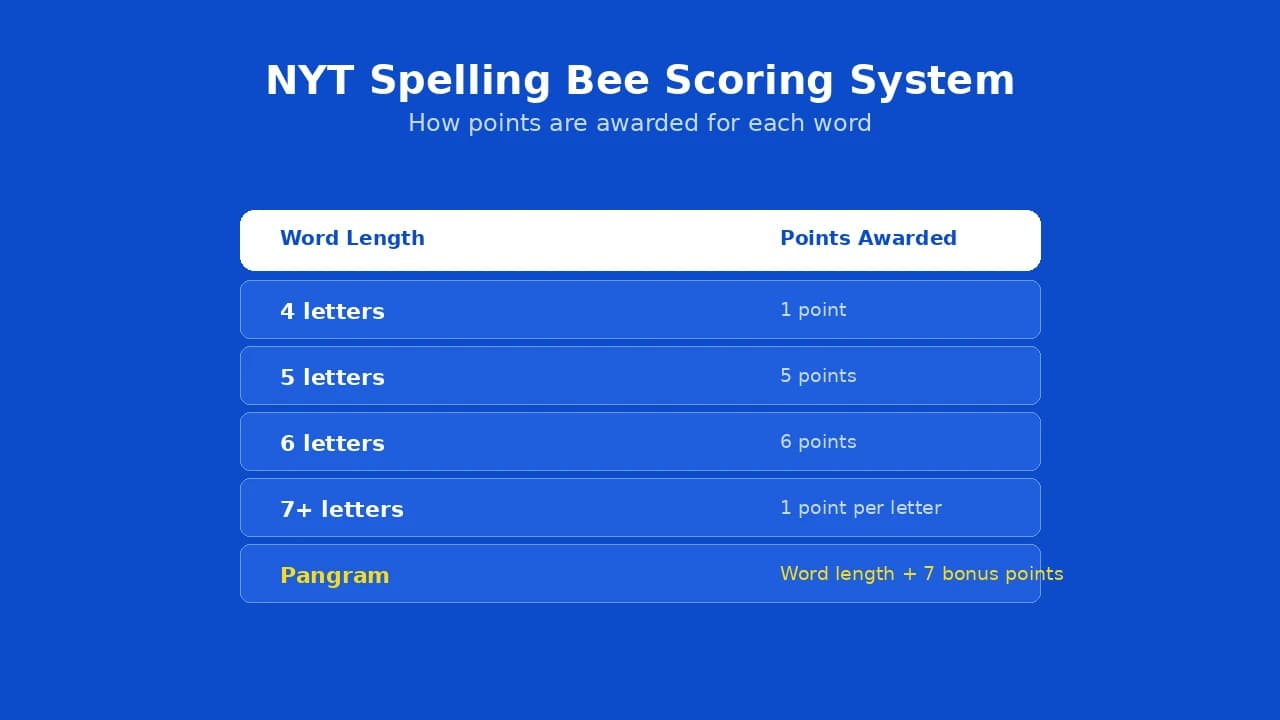
Longer words earn more under this point system, and your total points build toward the max score. Total possible points set a percentage-based scoring threshold, and score calculation happens automatically. Every rated points update gives a point boost toward five letter words and beyond, up to the maximum words and maximum possible words the puzzle allows, minus any plural exclusion.
Understanding the Ranks (Beginner to Queen Bee)
The ranking system moves you through a series of ranks as your score climbs:
- Beginner (beginner rank, good start)
- Good rank
- Moving up rank
- Nice rank
- Solid rank
- Great rank
- Amazing rank
- Genius rank (genius level)
- Queen Bee rank (queen bee status, queen bee title)
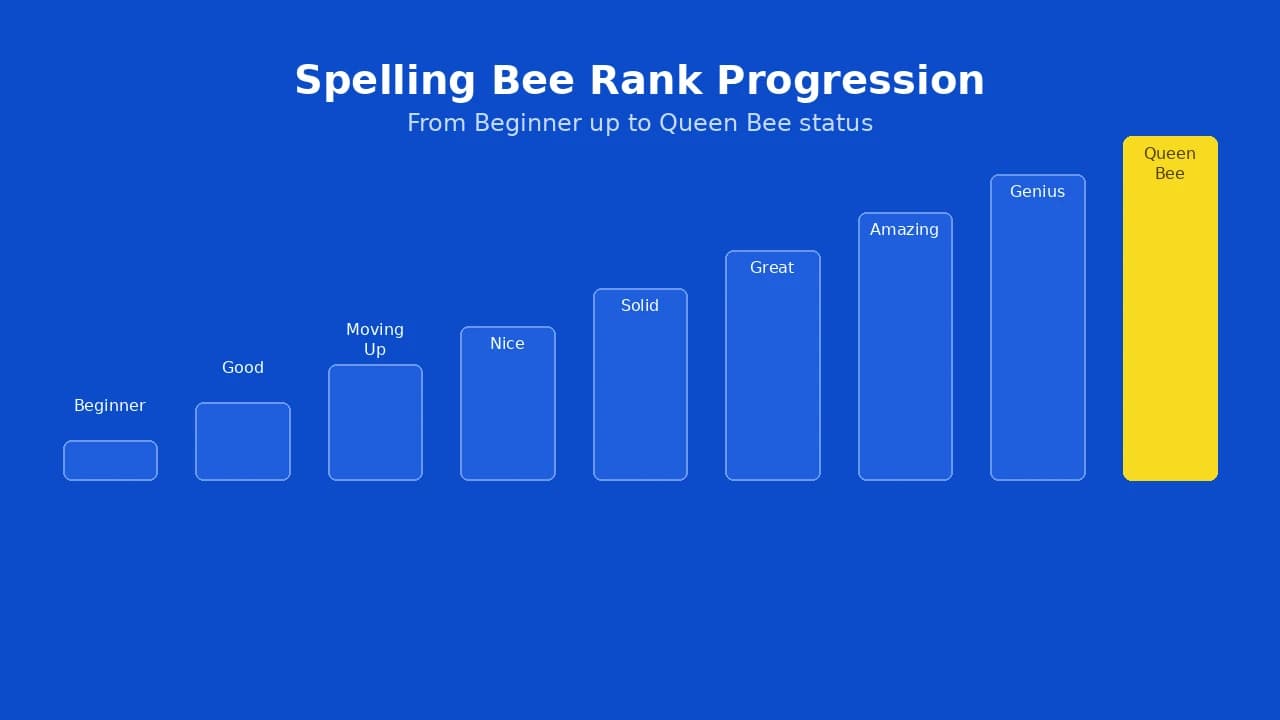
Each level system step marks real rank progression, tracked through milestones and achievements. Reaching the highest ranks takes practice, and hitting queen bee remains the most coveted, top rank status of all.
Tips for Mastering the NYT Spelling Bee
Learning how to solve Spelling Bee comes down to a few real Spelling Bee tips, Spelling Bee strategy moves, and a couple of Spelling Bee tricks. Mastering the game and improving your spelling skills just takes practice and a few smart habits.
Logic and Reasoning Techniques
Good logic and reasoning beat random guessing. Look for patterns and clusters, and get comfortable spotting patterns through basic pattern recognition. Word families built from a shared root word often unlock several answers at once, whether they're nouns, adjectives, verbs, or a shared stem. Start with short words, then build up. Try forming words and submitting answers through quick brainstorming, testing different combinations and possibilities as you go.
Using a Spelling Bee Solver Tool
A solver tool, or helper tool, works like a smart word finder among word game tools. Where an old solver might rely on a fixed prefix list, ours checks full 2 letter list and 3 letter list combinations through live search. It helps decode word guessing games and wordguessing puzzles fast, surfacing potential words, possible answers, and possible words. Depending on your letters, it confirms correct answers while you're still learning words and memorizing patterns.
Beginner Tips
New to the game? Start here:
- Follow a short beginners guide instead of guessing blind.
- Use a quick guide to learn the entry level basics.
- Play in short bursts at your own pace.
- Skip the time limit mindset. Timed puzzles and a timer aren't required.
- Give yourself thinking time before rushing an answer.
Speed and recall improve with patience and creativity. Staying curious keeps momentum going, and unusual or tricky words become easier to hunt down. Take short breaks for fresh eyes, since new possibilities often appear the moment you look again.
How to Achieve Queen Bee Rank
Climbing ranks toward queen bee takes real repetition. Score higher by chasing an improve score mindset, using every score boost you can find. Accumulate points steadily, since practicing regularly is how you improve rank over time. Uncover words you'd normally skip, and you'll steadily improve your expanding vocabulary with every future puzzle. A higher score, or higher scores overall, feels genuinely impressive once you land a good score or even a decent one. Avid users take their word list submissions seriously, and that habit is satisfying on its own.
Glossary of NYT Spelling Bee Terms
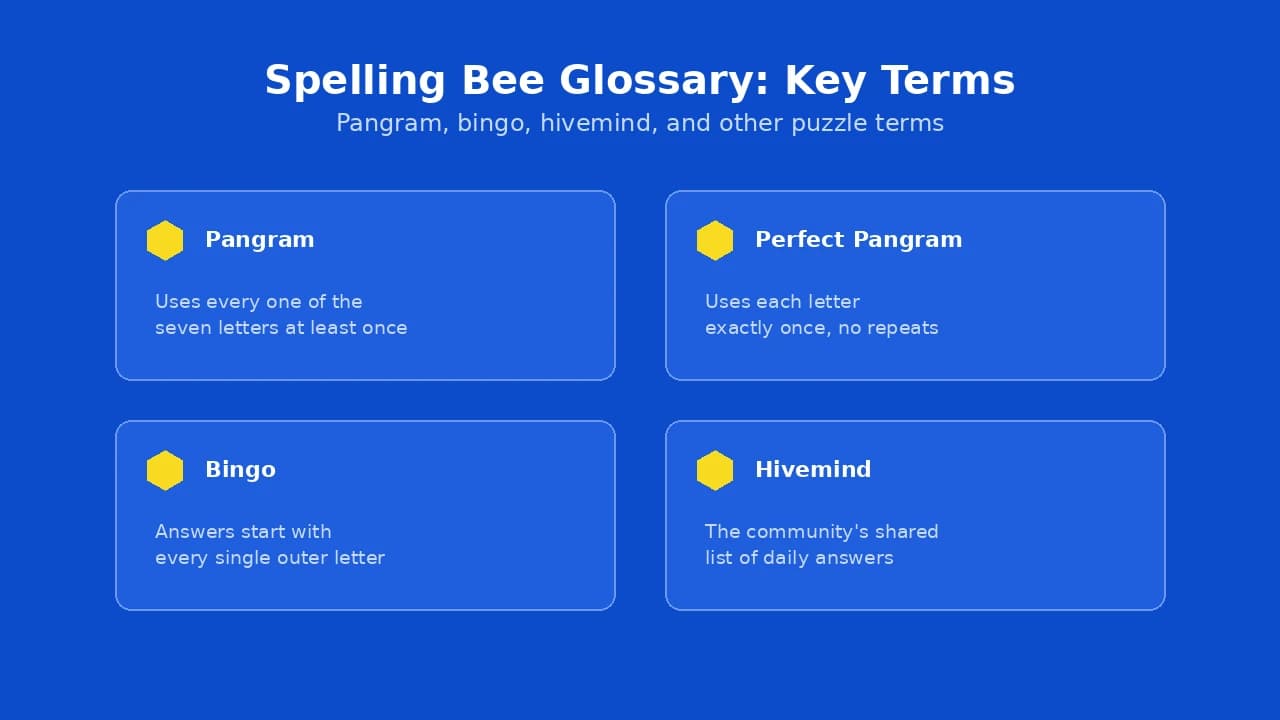
Every good glossary cuts through the jargon. Here are the core terms worth knowing, each with a plain definition, so the answer key and puzzle layout make sense the next time you open the puzzle letters.
Pangram
A pangram is a word that uses every one of the seven puzzle letters at least once. Some puzzles include more than one pangram, and every elusive pangram earns bonus points.
Perfect Pangram
A perfect pangram uses each letter exactly once, no repeats. It's rarer than a regular pangram and often counts toward a perfect score.
Hivemind
Hivemind is the community's shared answer list, built when the whole word game community works together. It reflects real community engagement across solvers.
Bingo
Bingo happens when a puzzle's answers use every outer letter to start at least one word. It's rare, so finding all words in a bingo puzzle is rarely seen.
The "S" Rule
The Spelling Bee never allows simple plurals ending in a lone S, an editorial decision meant to stop repeat words. This plural exclusion keeps the word list fair, and it often marks a puzzle's start word choices too.
Why Spelling Bee Is So Popular
Spelling Bee stays addictive and satisfying because it's simple on the surface but has real depth underneath. It's one of the most played, most discussed word games around, a true staple and standout in the daily word puzzle space. It's become a favorite pastime for good reason. Between the elusive pangrams and hidden strategy, the game strikes a rare blend of complexity and simplicity. That balance keeps engagement high, since the challenge stays dynamic enough for any wordsmith, enthusiast, or aficionado to enjoy.
Community and Competition
A big community keeps the game alive. Forums, a reddit community, and dedicated groups like the spelling bee subreddit and spelling bee forum let fans share ideas, discuss tricky puzzles, and exchange strategies. Players connect, celebrate a good pangram, and swap favorite words freely. It builds real motivation through leaderboards and friendly competition. Casual players, dedicated players, younger players, older players, and plenty of adults all join in, ad-free and low-pressure. For many, it's become a daily ritual, a small daily challenge that feels meditative, focused, and relaxing for busy individuals. It doubles as a mental workout, and swapping word associations with others adds real camaraderie, even when you're commiserating over a missed word.
Educational Benefits
Playing regularly brings real educational benefits. It enhances vocabulary and builds language skills that carry over into everyday life. That's what makes it critically useful, not just fun. It teaches transferable skills tied to reading and spelling, useful across any age range. It stays accessible for building vocabulary and mental agility, working on word formation and general entertainment at the same time. As a mental exercise, it sharpens cognitive skills and problem solving. Kids and adults both improve intellect and learn new words, in ways that echo classic schooling.
More NYT Games — Daily Hints & Answers
NYT Games publishes more than one hit. Beyond Spelling Bee, we track hints and answers, history, and archive stats for every major puzzle, including full game statistics. Check today's or yesterday's results below, sorted by developer and puzzle difficulty level.
Wordle Answers
Get today's Wordle answer here, plus a Wordle solver if you're stuck on a tough word.
Connections Answers
NYT Connections groups four sets of related words. Check daily Connections answers here the moment the puzzle drops.
NYT Mini Answers
The NYT Mini crossword is a quick daily crossword, smaller than the full puzzle. Full answers post here daily.
Strands Answers
Strands hides themed words inside a letter grid. Daily Strands answers post here right when the puzzle updates.
NYT Pips Solver
Solve today's NYT Pips puzzle fast with our daily answer breakdown.
Letter Boxed Solver
Letter Boxed challenges you to form words using a box-shaped word grid. Our solver checks every combination and letter combination so you never get stuck.
Contexto Answers
Get today's Contexto answer, plus the closest guesses, right here every day.
NYT Spelling Bee FAQs
How do I play the NYT Spelling Bee?
You get seven letters arranged in a honeycomb grid, with one letter locked in the center. Build real words using at least four letters, and always include the center letter. Every letter can repeat inside a single word. Find a pangram, using all seven letters, and you'll score a nice bonus.
Is there a Spelling Bee app I can use?
Yes, the NYT Games app has Spelling Bee built right in. You can also play it in your browser through the New York Times website. Either way, your progress and rank carry over. This spelling bee solver works alongside both, so you're never stuck.
Is NYT Spelling Bee free?
Mostly, yes. You get a handful of free words each day before it asks for a Games subscription. Once that limit hits, you'll need access to keep going. This spelling bee solver stays free the whole time, so you can check answers or hints without hitting any wall.
When does the NYT Spelling Bee get released?
A new puzzle drops every day at midnight Eastern Time. That's true whether you're on the East Coast or somewhere else, since the clock always runs on Eastern Time. This NYT Spelling Bee solver updates the moment that happens, so today's answers are ready right away.
What counts as a valid word?
It has to be four letters or longer, and it must include the center letter. Repeating letters is fine. Plurals ending in a lone S don't count, and neither do proper nouns, abbreviations, or offensive words. Everything else gets checked against a real dictionary before it's accepted.
How is my score calculated?
Four-letter words earn one point each. Anything longer earns one point per letter. Find a pangram, using every letter at least once, and you get a seven-point bonus on top. Add it all up, and that total decides your rank for the day.
What is considered a good score?
Genius usually sits around seventy percent of the total possible points. Anything past that puts you in rare company. A decent score still feels solid even below that mark, since most players never reach genius on tougher days. Consistency matters more than one big score.
How can I improve my rank?
Start with short, easy words first, then build outward. Look for common prefixes and suffixes hiding inside the letters. Practicing daily helps you spot patterns faster over time. And when you're stuck, this Spelling Bee solver can nudge you toward the next word.